

 +44 (0)333 202 6800
Designing Low-Maintenance Landscapes for Commercial Developments
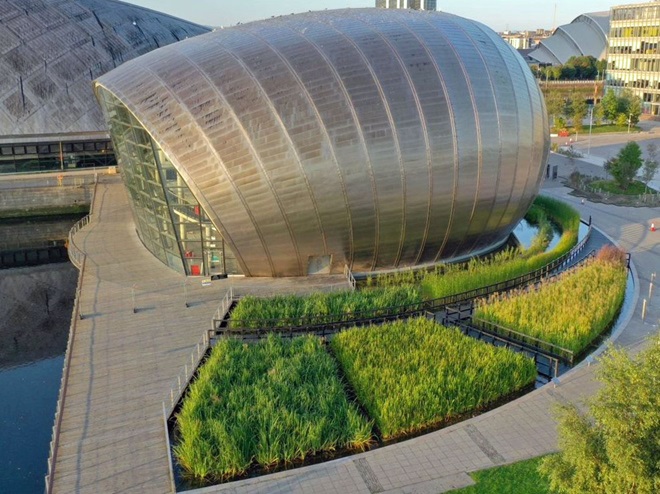
Commercial landscapes need to look good when a development opens, but successful landscape design also needs to consider what happens five, ten and potentially many more years into the future.
Business parks, retail developments, hospitality destinations, residential developments and mixed-use schemes can contain substantial areas of external infrastructure. Seating, pathways, planted areas, boundaries, decking and other landscape features are continuously exposed to weather, moisture and everyday use.
Every element that requires painting, treating, repairing or replacing creates an ongoing maintenance requirement.
For landscape architects, developers, contractors and facilities teams, low-maintenance landscaping therefore starts long before the first maintenance visit. It begins with the materials specified during design.
Recycled Plastic for Landscaping
Explore how thoughtful material selection can reduce future maintenance requirements while creating practical, attractive and durable commercial landscapes.
What does low-maintenance landscaping actually mean?
Low maintenance does not mean no maintenance.
Plants still need managing, surfaces need cleaning and infrastructure should be inspected. The objective is to reduce avoidable and repetitive tasks that result from the materials and products originally specified.
These can include:
- Painting and staining
- Applying preservative treatments
- Replacing rotten components
- Repairing split or warped materials
- Managing corrosion
- Replacing deteriorated edging
- Repairing damaged landscape features
- Replacing outdoor furniture prematurely
The cumulative impact can be considerable across a large commercial site.
A more effective approach is to consider whole-life maintenance requirements when the landscape is first designed.
Designing low-maintenance landscaping for real-world conditions
Computer-generated visualisations and landscape plans naturally focus on how a completed development will look.
However, materials should also be assessed according to the conditions they will experience once installed.
Consider:
- Will the area remain damp for prolonged periods?
- Will components have direct contact with soil?
- Is standing water possible?
- How much pedestrian traffic is expected?
- Will maintenance vehicles operate nearby?
- Is the development exposed to coastal conditions?
- Will areas be difficult to access for future maintenance?
- Could vegetation grow around the installation?
- How frequently will facilities teams realistically be able to maintain it?
A product that performs well in a sheltered environment may not necessarily be appropriate beside a pond, within planting beds or in permanently exposed areas.
Material selection should therefore respond to the micro-environments across the development.
Look closely at ground-contact materials
Ground level is one of the most demanding areas within a landscape.
Landscape edging, retaining elements, posts, substructures and other components can experience prolonged contact with wet soil and vegetation.
Where timber is used, moisture can contribute to deterioration and ultimately rot. This can result in components needing treatment, repair or replacement.
Recycled plastic lumber provides an alternative for appropriate ground-contact applications because it does not rot when exposed to moisture.
Potential landscaping applications include:
- Landscape edging
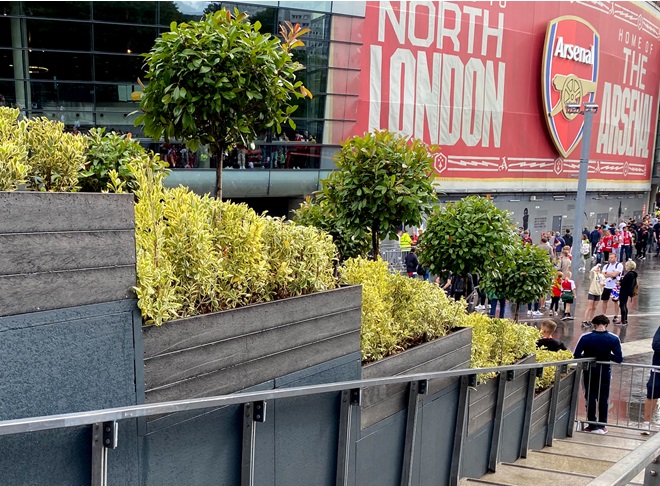
- Raised beds and planters
- Retaining applications
- Posts
- Pathway edges
- Landscape structures
- Bespoke fabricated elements
Plaswood recycled plastic lumber profiles are available in a variety of dimensions and can be cut and fabricated for different landscaping applications.
Design planting areas for easier management
Plant selection naturally has a major influence on future landscape maintenance, but the infrastructure surrounding planting also matters.
Clearly defined beds and robust edging can help separate planting from:
- Lawns
- Paths
- Gravel
- Parking areas
- Pedestrian routes
Well-designed boundaries can make mowing, pruning and general grounds maintenance more straightforward while helping the original landscape design retain its definition.
Raised planters can also introduce planting where conventional beds are impractical and help create defined zones within larger commercial spaces.
Where edging or planter components will remain in direct contact with damp soil, material longevity should form part of the specification.
Think about outdoor furniture as infrastructure
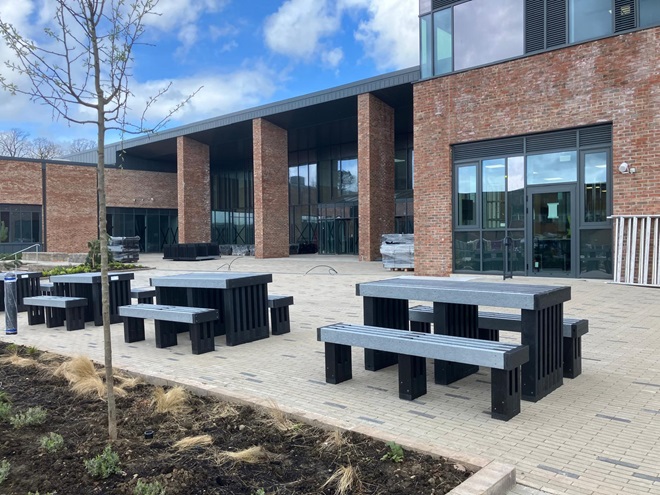
Benches and picnic tables are sometimes treated as finishing touches, but within a commercial landscape they should be considered long-term site infrastructure.
Outdoor furniture may be exposed to:
- Rain and frost
- UV exposure
- Food and drink
- Heavy daily use
- Dirt and vegetation
- Regular cleaning
Maintenance requirements can become particularly important on developments containing numerous seating areas.
Traditional timber furniture may require periodic painting, staining or other treatments and can become susceptible to rot and splintering over time.
Recycled plastic outdoor furniture does not rot or splinter and requires no painting, staining or preservative treatment.
For commercial developments, potential applications include:
- Employee breakout spaces
- Communal courtyards
- Public seating
- Picnic areas
- Landscaped gardens
- Retail environments
- Hospitality spaces
- Rest areas along pedestrian routes
Furniture selection should also consider accessibility, fixing requirements and how people are expected to use the surrounding space.
Protect decking from the ground up
A deck is only as durable as the structure supporting it.
Visible deck boards often receive most of the attention during specification, but the substructure can be exposed to some of the most challenging conditions.
Joists and supporting components may experience:
- Restricted airflow
- Persistent moisture
- Vegetation
- Ground contact
- Water collecting beneath the deck
If the visible surface remains serviceable but the supporting structure deteriorates, substantial remedial work may still be required.
Recycled plastic joists and profiles can provide a rot-resistant substructure for appropriate decking applications, helping reduce the risk of deterioration associated with timber decay within the supporting structure.
This can be particularly valuable where access beneath a completed deck will be difficult.Explore Plaswood's recycled plastic decking products when considering external decking and substructure requirements.
Consider pathways, boardwalks and access routes
Commercial landscape design frequently needs to connect buildings, car parks, gardens, water features and recreational areas.
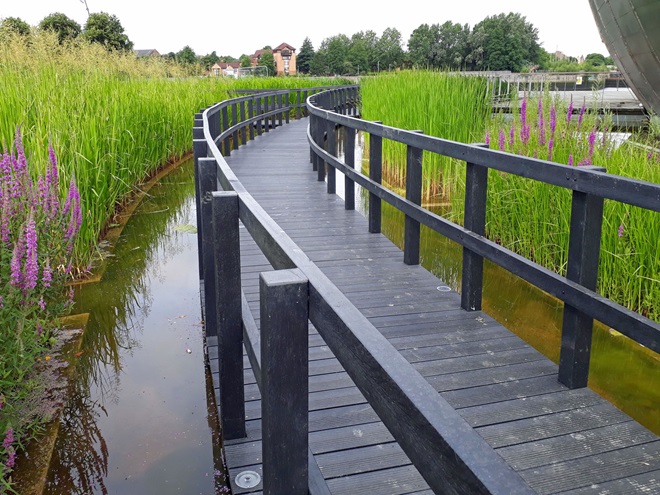
Some routes can be created using conventional paving, but developments containing softer landscapes, wetlands, woodland areas or water features may require elevated pathways or boardwalks.
These environments introduce additional maintenance considerations because the structure can be continuously exposed to moisture.
Recycled plastic is particularly suited to wet environments because it does not rot as a result of water exposure.
It can therefore be considered for applications including:
- Boardwalks
- Nature trails
- Waterside routes
- Access across soft ground
- Paths through landscaped areas
For large developments, incorporating durable access infrastructure at the design stage can help avoid disruptive replacement work once the surrounding landscape has matured.
Don't forget boundaries and fencing
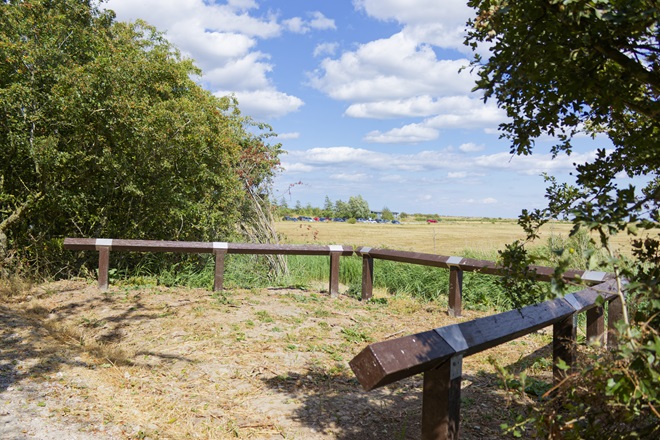
Fencing can represent a considerable quantity of material across a commercial development.
It may be required to:
- Define site boundaries
- Separate different landscape areas
- Protect planting
- Control pedestrian movement
- Screen operational areas
- Create decorative landscape features
As with other ground-contact products, posts and lower sections of timber fencing can be vulnerable to moisture.
Recycled plastic fencing provides an alternative where resistance to rot and reduced maintenance are priorities.
Depending on the project, different styles can also help fencing fulfil either a functional or more decorative landscape role.
Use materials to create consistency across a development
One advantage of considering materials at development level rather than product level is the opportunity to create consistency.
Recycled plastic can potentially be used across multiple landscape elements, including:
- Furniture
- Edging
- Planters
- Fencing
- Decking substructures
- Boardwalks
- Signage
- Bollards
- Bespoke landscape features
This does not mean every external element needs to use the same material.
Instead, landscape architects can identify areas where particular environmental conditions or maintenance challenges make recycled plastic appropriate and use it strategically alongside planting, paving, stone, metal and other materials.
The result can be a landscape that retains design variety while reducing maintenance in particularly vulnerable areas.
Consider maintenance access during the design stage
One of the simplest principles of low-maintenance landscape design is also one of the easiest to overlook:
If something will require regular maintenance, how will somebody reach it?
A component that is straightforward to repair during construction may become difficult to access once buildings, planting and surrounding infrastructure are complete.
Consider whether future maintenance would require:
- Removing established planting
- Closing pedestrian routes
- Lifting deck boards
- Bringing machinery into landscaped areas
- Working around customers, employees or residents
- Temporarily closing facilities
Materials with lower maintenance requirements can be particularly valuable in areas where future access will be difficult, expensive or disruptive.
Evaluate whole-life value rather than individual product cost
Low-maintenance commercial landscape design requires a broader view of cost.
The initial price of a material or product should be considered alongside the expenditure it could generate throughout its service life.
A useful comparison should include:
- Cost consideration What to assess
- Purchase Initial material or product cost
- Installation Labour and preparation requirements
- Treatment Painting, staining, sealing or preservatives
- Routine maintenance Frequency and cost of ongoing work
- Repairs Likely deterioration and repair requirements
- Access Cost and disruption involved in reaching the product
- Replacement Expected frequency and cost of replacement
- Disposal Requirements when components reach the end of their service life
This becomes increasingly important as the scale of the development increases.
Saving a relatively small amount on one component may appear attractive during construction. Multiplied across hundreds of metres of edging, fencing or multiple pieces of outdoor furniture, however, recurring maintenance can become a substantial facilities-management commitment.
Sustainability and material longevity
Environmental objectives increasingly influence commercial landscape specifications.
Recycled content is one consideration, but longevity and maintenance requirements should also form part of material evaluation.
Questions for project teams can include:
- What is the product manufactured from?
- Does it contain recycled material?
- What maintenance treatments will it require?
- How frequently might it need replacing?
- Can components be repaired or replaced individually?
- Where is the product manufactured?
- What happens to the material at the end of its useful life?
Plaswood manufactures recycled plastic products in the UK from recycled material, creating durable products for a wide range of external applications.
Using recycled material in a product designed for prolonged outdoor use provides one way for commercial developments to incorporate recycled resources into functional landscape infrastructure.
Where could recycled plastic be incorporated into a commercial landscape?
Rather than starting with individual products, it can be useful to review the development as a whole and identify areas where moisture, ground contact, heavy use or difficult maintenance access create particular challenges.
Potential opportunities include:
Entrances and arrival areas
- Benches
- Bollards
- Signage
Pedestrian routes
- Edging
- Signage
- Seating
- Boardwalk sections
Communal spaces
- Benches
- Picnic tables
- Planters
Planting areas
- Edging
- Raised beds
- Posts
- Bespoke landscape structures
Boundaries
- Fencing
- Posts
Decked areas
- Decking
- Rot-resistant substructures
Natural and waterside areas
- Boardwalks
- Viewing platforms
- Seating
- Signage
This approach allows recycled plastic to be specified where its material characteristics provide the greatest practical value.
Low-maintenance commercial landscaping checklist
When planning a commercial landscape, ask:
- What level of maintenance can the site realistically support?
- Which materials will be in permanent contact with soil or moisture?
- Where could rot or corrosion create future problems?
- Which areas will be difficult to access once construction is complete?
- How much outdoor furniture will require ongoing maintenance?
- Have accessible furniture and routes been incorporated?
- Are deck substructures being considered alongside the visible surface?
- What is the expected whole-life cost rather than simply the purchase price?
- Could one durable material solve several different landscape requirements?
- Have future facilities and maintenance teams been considered during specification?
Designing low-maintenance landscapes for the long term
A successful commercial landscape should continue to work long after construction teams have left the site.
Planting will mature and spaces will evolve, but the infrastructure supporting those landscapes needs to remain functional.
By considering durability, moisture exposure, ground contact, maintenance access and whole-life value during specification, landscape architects and developers can reduce avoidable future maintenance and create external spaces that are easier for facilities teams to manage.
Recycled plastic will not be the appropriate material for every element of every landscape. However, where traditional materials are vulnerable to rot, splintering or repeated treatment requirements, it provides a practical alternative worth considering.
Plaswood manufactures recycled plastic lumber and finished products for commercial landscaping applications, including furniture, fencing, decking, edging and other landscape infrastructure.
Explore our Landscaping solutions and recycled plastic lumber range, or speak to the Plaswood team about material requirements for your next commercial landscape project.
Frequently Asked Questions
What materials are suitable for low-maintenance commercial landscaping?
The appropriate materials depend on the application and environment. Stone, suitable metals, paving products and recycled plastic can all contribute to low-maintenance landscapes. For areas exposed to moisture or ground contact, recycled plastic can be particularly useful because it does not rot and requires no painting, staining or preservative treatment.
Is recycled plastic suitable for landscape edging?
Yes. Recycled plastic lumber can be used for appropriate edging applications and is resistant to rot when exposed to damp soil and vegetation.
Can recycled plastic be used for commercial landscape furniture?
Yes. Recycled plastic benches and picnic tables are suitable for commercial outdoor environments and can provide an alternative to timber where low maintenance and resistance to rot and splintering are priorities.
Can recycled plastic be used below decking?
Recycled plastic profiles can be used to create rot-resistant decking (link to /lumber/decking/) substructures for appropriate applications. This can be particularly useful where the supporting structure will experience prolonged moisture exposure or be difficult to access after installation.
Does recycled plastic need painting or treating?
Plaswood recycled plastic does not require painting, staining or preservative treatments. Routine maintenance is primarily focused on cleaning and appropriate inspection of the completed installation.
Is recycled plastic suitable around water?
Recycled plastic's resistance to rot makes it suitable for many waterside and wet-environment applications. Plaswood products are used for applications including boardwalks and other landscape infrastructure where exposure to moisture is an important specification consideration.
Need more information?
Our team is here to help you find the solution. Get in touch and we'll answer your questions.
